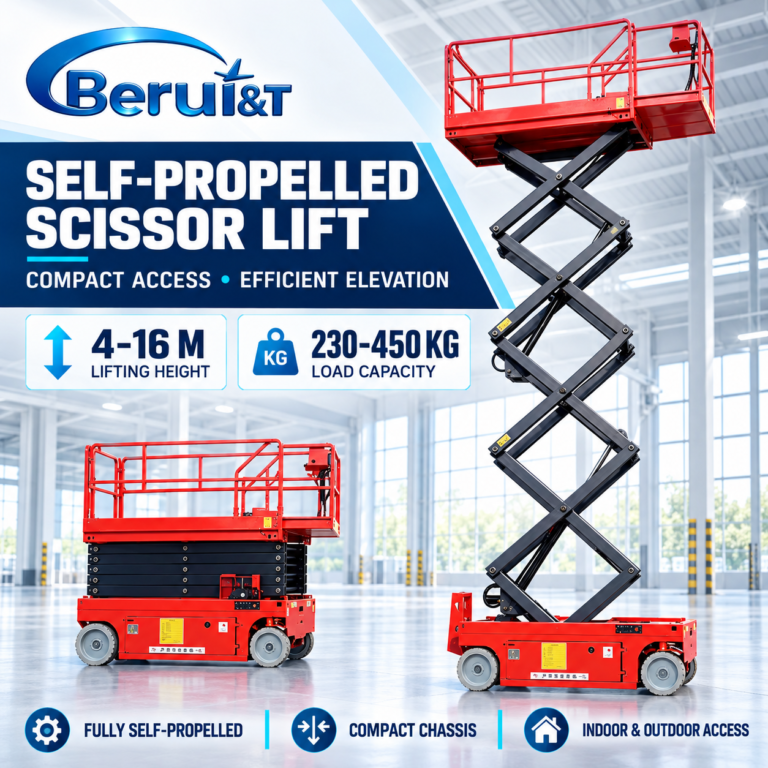

Self-Propelled Scissor Lift: Features, Applications and Buying Guide
Self-propelled scissor lifts have become essential equipment for modern aerial work. From construction sites and warehouses to factories and commercial buildings, these machines provide an efficient way for workers to reach elevated work areas.
Compared with traditional manually moved lifting platforms, self-propelled scissor lifts offer greater mobility, convenient operation, and improved productivity.
In this guide, we will explore how self-propelled scissor lifts work, their main advantages, common applications, and important factors to consider when choosing the right model.
1. What Is a Self-Propelled Scissor Lift?
A self-propelled scissor lift is a mobile elevated work platform designed to lift workers, tools, and materials to a specified working height.
The machine uses a scissor-shaped lifting mechanism to raise and lower the platform vertically.
Unlike manually pushed scissor lifts, self-propelled models feature an integrated driving system that allows operators to move and steer the equipment using platform-mounted controls.
Most electric self-propelled scissor lifts are powered by rechargeable batteries, making them suitable for various indoor and outdoor applications.
These machines are commonly used for installation, maintenance, inspection, cleaning, and construction projects.
2. Key Features of Self-Propelled Scissor Lifts
Fully Self-Propelled Operation
One of the main advantages of a self-propelled scissor lift is its integrated driving system.
Operators can control driving, steering, lifting, and lowering directly from the working platform.
This reduces the need for manual repositioning and helps improve productivity when working across multiple locations.
Electric Battery-Powered System
Electric scissor lifts use rechargeable batteries to power their operating systems.
Compared with diesel-powered aerial work platforms, electric models offer quieter operation and no direct exhaust emissions during use.
This makes them particularly suitable for indoor environments such as factories, warehouses, shopping malls, and commercial buildings.
Stable Scissor Lifting Structure
The scissor mechanism provides vertical lifting through a series of interconnected steel supports.
A properly designed lifting structure helps maintain platform stability during normal operation within the manufacturer’s specified limits.
Operators must always follow the equipment’s rated load capacity, ground-condition requirements, and operating instructions.
Compact and Flexible Design
Many electric scissor lifts feature compact dimensions, allowing them to move through relatively narrow working areas.
Depending on the model, they can be used in warehouses, workshops, maintenance corridors, and other locations where larger aerial work platforms may be unsuitable.
Multiple Safety Features
Depending on the model and configuration, self-propelled scissor lifts may include:
- Emergency stop controls
- Emergency lowering systems
- Tilt warning or protection systems
- Automatic braking systems
- Platform guardrails
- Overload protection
Safety configurations should always be confirmed according to the specific model and applicable market requirements.
3. Common Applications of Self-Propelled Scissor Lifts
Self-propelled scissor lifts are widely used across different industries.
Construction and Building Renovation
Electric scissor lifts provide elevated access for ceiling installation, interior decoration, electrical work, and other building renovation tasks.
They are especially useful when workers need a stable platform and sufficient space for tools.
Factory and Industrial Maintenance
Manufacturing facilities regularly require equipment inspection, lighting maintenance, pipe installation, and overhead machinery servicing.
Self-propelled scissor lifts allow maintenance teams to move between working areas more efficiently.
Warehouse and Logistics Facilities
Warehouses often require elevated access for lighting installation, building maintenance, inventory-related tasks, and equipment inspection.
Compact electric models can be suitable for indoor warehouse operations when floor conditions and available space meet equipment requirements.
Commercial Building Maintenance
Shopping malls, exhibition centers, airports, and other commercial facilities use aerial work platforms for lighting maintenance, cleaning, decoration, and inspection.
Battery-powered operation is particularly useful in noise-sensitive indoor environments.
Road and Municipal Maintenance
Self-propelled scissor lifts can also be used for certain outdoor maintenance tasks, including signage installation, streetlight servicing, and municipal facility maintenance.
For these applications, operators must ensure that the ground is firm, level, and suitable for the selected machine.
Uneven or soft ground may require a specially designed rough-terrain or crawler scissor lift.
4. How to Choose the Right Self-Propelled Scissor Lift
Selecting the correct aerial work platform depends on several important factors.
Working Height
Working height is one of the most important specifications.
It generally refers to the approximate maximum height a worker can reach while standing on the elevated platform.
Platform height and working height are different measurements and should not be confused.
For example, a scissor lift with a 12-meter platform height may have an approximate working height of 14 meters, depending on the manufacturer’s specification.
Load Capacity
Load capacity determines the maximum permitted weight on the platform, including workers, tools, and materials.
Buyers should calculate the total expected load and select a model with a suitable rated capacity.
Platform Dimensions
A larger platform can provide more working space for operators and equipment.
However, buyers should also consider access restrictions, transportation dimensions, and available working space.
Indoor or Outdoor Use
For indoor applications, compact electric scissor lifts are often preferred because of their low noise and maneuverability.
For outdoor environments with uneven or muddy ground, rough-terrain or crawler scissor lifts may be more suitable.
Power Supply and Battery System
Battery capacity, charging requirements, and expected operating time should be considered when selecting an electric scissor lift.
The most suitable configuration depends on the working environment and daily operating requirements.
5. Self-Propelled Scissor Lift Specifications
At Berui Machinery, we supply electric self-propelled scissor lifts for a variety of industrial and construction applications.
Our product range includes models with the following available specifications:
| Specification | Available Range |
|---|---|
| Product Type | Self-Propelled Electric Scissor Lift |
| Lifting Height | 4–18 m |
| Load Capacity | Up to 320 kg |
| Drive System | Electric Self-Propelled |
| Power Source | Rechargeable Battery |
| Main Applications | Construction, Maintenance, Warehousing, Building Renovation |
Specifications vary by model. Please contact our team for detailed technical data and available configurations.
6. Why Choose Berui Machinery?
Berui Machinery supplies hydraulic lifting equipment and aerial work platforms for industrial, construction, and maintenance applications.
Our product range includes self-propelled scissor lifts, crawler scissor lifts, rough-terrain scissor lifts, mast lifts, and other lifting solutions.
We help customers select suitable equipment according to their working height, load capacity, platform dimensions, power requirements, and operating environment.
Whether you are an equipment distributor, contractor, rental company, or industrial end user, our team can assist with product selection and quotation inquiries.
7. Frequently Asked Questions
What is the difference between a self-propelled scissor lift and a mobile scissor lift?
A self-propelled scissor lift has an integrated drive system that allows powered movement.
A manually moved scissor lift normally requires external pushing or towing for repositioning.
Can electric scissor lifts be used outdoors?
Yes. Electric scissor lifts can be used outdoors when the specific model is approved for outdoor operation and site conditions meet the manufacturer’s requirements.
What is the difference between platform height and working height?
Platform height is the maximum elevation of the platform floor.
Working height is an estimated maximum reach height for a person standing on the platform.
Can a scissor lift operate on uneven ground?
Standard electric scissor lifts generally require firm, level ground within their specified operating limits.
For uneven terrain, a rough-terrain or crawler scissor lift with appropriate stabilization features may be more suitable.
How do I select the correct model?
Consider working height, rated load capacity, platform dimensions, operating environment, power supply, and transportation requirements.
Consult the equipment supplier to confirm the appropriate configuration.
Conclusion
Self-propelled scissor lifts offer a practical solution for elevated work in factories, warehouses, construction sites, and commercial facilities.
Their electric drive systems, convenient controls, and vertical lifting capabilities make them useful for a wide range of maintenance and installation tasks.
Choosing the correct model is essential for efficient operation and workplace safety.
Looking for a reliable self-propelled scissor lift supplier?
Contact Berui Machinery to discuss your project requirements and request detailed product specifications and a quotation.